
Wood
Wood is a hard fibrous substance or product found beneath the bark of trees. Two types of trees:gymnosperms and angiosperms provide the wood that are commonly known as timber . Gymnosperms produce the type of wood known as coniferous wood or softwood the angiosperms are known as dicotyledonous wood or hardwood. The term softwood and hardwood does not indicate the softness or hardness of each. This distinction is basically for the purpose of classification because of the structure of the wood. A growing tree has roots that anchor it to the ground and obtain water and minerals salt from the soil, trunk or stem that stand arect and crown which is composed of branches twigs and leaves. Wood tissue is MOformed by the layer of living cells called camium layer. The cambium form on the inside new wood tissue while it forms on it’s outside, new back there by increasing in diameter of trunks and branches.
Types of wood 1.Softwood-
Softwood trees generally have conical cells and needle -like leaves. The trees grow mainly in temperate claim with the leaves evergreen. Some common trees that produce softwood include ; pines ,first,larch and spruce.
2.Hardwood –
Trees that are deciduous with broad leaves which are shed in winter season produce the type of wood known as hardwood. Cells of these types of trees are ash, oak, birch, elm, sycamore, iriko, beech, mahogany, walnut etc.
STRUCTURE OF WOOD —
Wood is composed of a number of minute cells of different shapes, purposes and structures. Cells of wood are box-like in structure composed of thin and soft cellulose when they are newly formed. Each cell is made up of a quantity of thin slimy liquid known as protoplasm and nucleus as the living organism. As the tree ages, some changes take place, causing the cells to lose their protoplasm while some cells still retain it. Older cells whose protoplasm disappears have their walls becoming thick and hardened. This is known as signification. These cells stop growing but serve the function of giving strength to hold the tree to stand erect.
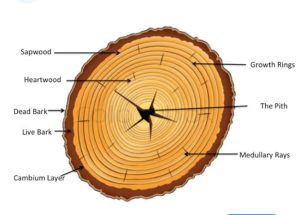
When the tree was cut the cross-section reveal the following parts:-
1. Pith — This is soft cylindrical shaped tissue surrounded by layers of dead cells of wood.it represents the early growth of the tree spanning throughout the length of the tree trunk.
2. Cambium Layer — This is a layer of wood cells that completely envelopes the spawood . It is in this layer of cells that the growth of the tree takes place both radially and tangentially. Wood cells are formed on the inner part of the cambium and the bast or phloem is formed on the outside.
3. Annual Rings — Also known as growth rings because each ring represents one season’s growth in the tree.
4. Heartwood — These are layers of wood tissue that have stopped playing any active role in the growth of the tree. It gives the tree strength as well as serves as the storage of products such as resin, gum, and tanning.
5. Sapwood — This is wood composed of newly formed cells that are not fully lingnified. It is through the cells of sapwood that water and dissolved mineral salt are connected to the all branches and the leaves where the food is manufactured for the tree by the process of photosynthesis.
6. Bast — This is a layer of greenish tissue that surrounds the cambium. It has some tube-like cells through which manufactured food from the leaves is distributed to all parts of the tree.
7. Bark — This is the external layer of dead cells of the tree. It forms a layer of impervious skin that prevents transpiration of moisture from the trunk of the tree.
8. Medullary Rays — These are thin sheets of wood tissue that stand vertical but elogate radially. These rays extend from the cambium to the medulla. They serve the function of distributing waste products to other parts of the tree for stronge in cells that are manufacture.
These are the features illustrated in the figure below:
THE WAYS OF CUTTING THE TREE
- Felling of Trees — This is the process of cutting down the forest before they are cut into marketable timber.felling of trees is Carried out in winter season because the moisture content is low, making the seasoning period to be short. Also there is less dangerous insect and fungi attack when wood is felled in this period.
- Conversion of wood — This is a term that describes the process of cutting wood logs into marketable sizes. Methods of wood conversion vary with the type of wood and market requirements
- Marketable sizes of wood —
- Log — A length of wood cut from the trunk or large branch of tree from which timber and veneer are cut.
- Billet — This is a long wood that is less than 3.5m.
- Scantling — A sma piece of wood up to 150mm wide and 38 — 100mm thick. It is used for small beams and framed structures such as rafters, studs and joists.
- Heavy Scantling — A piece of wood that is over 150mm * Over 100mm. It is used for heavy structural work and for cutting to smaller sections.
- Boards — Wood pieces that are 75mm or more, wide and 10 — 38mm thick. They are used as rough sawn wood in building construction. They are also dressed for painted woowork and joinery, flooring, shelving, furniture construction etc.
This distinction is basically for the purpose of classification because of the structure of the wood. A growing tree has roots that anchor it to the ground and obtain water and minerals salt from the soil, trunk or stem that stand arect and crown which is composed of branches twigs and leaves. This is all about Woods which is very useful for Building construction and other necessary things apart of construction. Wood is major materials used in some of the construction. To know it types and Quality it may help you for making good properties.